

A Chronological Overview of the Development of Tractors in the United States
Here is a clear, chronological overview of the development of tractors in the United States, with key technological, economic, and agricultural milestones.
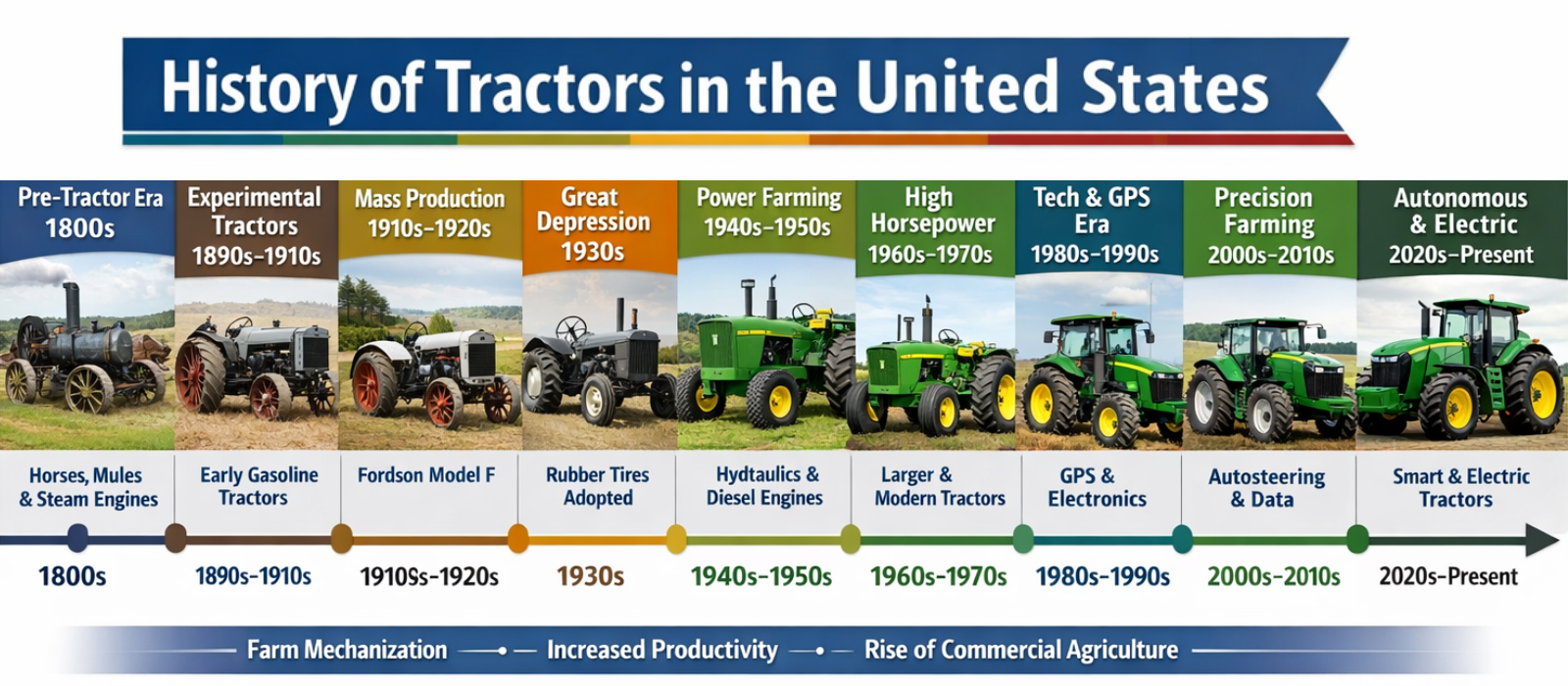
1. Pre-Tractor Era (Before 1890s): Animal & Steam Power
1700s–1800s
U.S. farming relied on horses, mules, and oxen.
Steam-powered traction engines appeared in the mid–late 1800s.
Used mainly for:
Threshing
Plowing large prairie farms
Limitations: heavy, dangerous, expensive, and impractical for small farms.
Key Impact: Set the foundation for mechanized agriculture.
2. Experimental Gasoline Tractors (1890s–1910s)
1890–1915
First internal combustion farm tractors emerge.
Early innovators:
John Froelich (1892) – built one of the first successful gasoline tractors in Iowa.
Hart-Parr Company (1901) – coined the term “tractor.”
Early tractors were:
Large
Steel-wheeled
Unreliable
Expensive
Key Models:
Hart-Parr 30-60
Rumely OilPull
Impact: Proved that gasoline power could replace animals and steam.
3. Mass Production & Farm Adoption (1910s–1920s)
1915–1930
Introduction of affordable tractors.
Fordson Model F (1917):
First mass-produced tractor
Affordable for small farmers
Companies expand:
John Deere
International Harvester
Allis-Chalmers
Case
Technological Advances:
Assembly-line manufacturing
Improved carburetors
Better transmissions
Impact:
Tractor ownership explodes.
Horse populations decline.
Farm productivity increases dramatically.
4. Depression & Standardization (1930s)
1930–1939
Great Depression slowed purchases.
Manufacturers focused on:
Reliability
Cost efficiency
Standard parts
Major Innovation:
Rubber tires (late 1930s) replaced steel wheels.
Increased speed
Reduced soil compaction
Improved comfort
Impact: Modern tractor form begins to emerge.
5. Power Farming Boom (1940s–1950s)
1940–1959
WWII spurred mechanization.
Labor shortages increased demand.
Postwar economic boom accelerated adoption.
Key Innovations:
Hydraulic lifts (Ferguson System)
Three-point hitch
Power Take-Off (PTO) standardization
Diesel engines become common
Major Brands:
John Deere
Massey-Harris-Ferguson
International Harvester
Impact:
One farmer could manage far more land.
Rise of commercial-scale farming.
6. High Horsepower & Specialization (1960s–1970s)
1960–1979
Larger farms → larger tractors.
Introduction of row-crop, utility, and articulated tractors.
Innovations:
Turbocharged diesels
Power steering
Enclosed cabs (with heating/AC)
Four-wheel drive
Notable Models:
John Deere 4020 (1964)
Steiger articulated tractors
Impact: Expansion of industrial-scale agriculture.
7. Electronics & Efficiency (1980s–1990s)
1980–1999
Farm crisis of the 1980s reduces sales.
Focus shifts to:
Efficiency
Durability
Technology
Technological Advances:
Electronic fuel injection
Onboard computers
GPS guidance (late 1990s)
Load-sensing hydraulics
Impact: Beginning of “precision agriculture.”
8. Precision & Automation (2000s–2010s)
2000–2019
Widespread adoption of GPS and automation.
Key Developments:
Auto-steer systems
Variable-rate seeding
Telematics
Yield monitoring
Emissions controls (Tier 4)
Manufacturers:
John Deere
CNH Industrial
AGCO
Impact: Data-driven farming becomes mainstream.
9. Smart, Autonomous & Electric Era (2020s–Present)
2020–2026
Focus on sustainability and autonomy.
Current Trends:
Autonomous tractors (John Deere, Monarch)
Electric tractors
AI-assisted field management
Remote fleet monitoring
Carbon reduction technologies
Examples:
John Deere autonomous 8R
Monarch MK-V Electric
Impact: Transition toward labor-light, software-driven agriculture.
10. Long-Term Impact on American Agriculture
EraAvg. Acres per FarmerLabor NeedsProductivity1900~150Very HighLow1950~220MediumHigh2000+1,000+LowVery High
Overall Effects:
Reduced farm labor by over 90%
Enabled large-scale food production
Lowered food prices
Reshaped rural economies